
When people talk about the Algarve, the first image that usually comes to mind is the coast: the beaches, the cliffs, the sea, the hotels, the restaurants and the thousands of tourists who arrive in the region every year in search of sunshine and holidays. But there is another Algarve, less well known, more discreet, and deeply shaped by the relationship between people, nature and the land. This is the inland Algarve, a territory that continues to preserve an important part of the Algarve’s identity and which, despite the challenges it faces, is beginning to reveal renewed potential for the future.
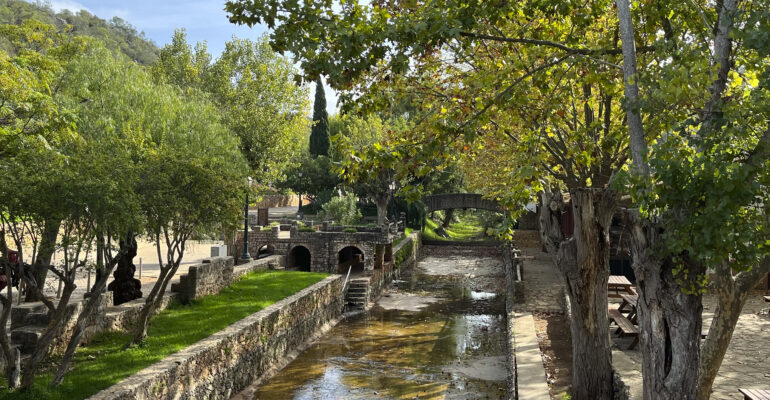
It only takes a few kilometres to leave behind the Algarve’s best-known landscape and enter a completely different territory. Wide avenues and tourist areas give way to narrower roads, small villages, hills, valleys, streams, vegetable gardens, orchards and rural landscapes that remain deeply connected to the ways of life of previous generations. Querença, Tôr, Salir, Alte, Benafim and Ameixial are examples of places where this other Algarve reality becomes particularly evident. These are communities where natural and cultural heritage remains part of everyday life, where it is still possible to find springs, waterwheels, windmills, stone walls, traditional orchards, rural paths and agricultural systems that bear witness to an ancient relationship between people and the land.
This territory is, at the same time, a place of memory and a place of the future. For decades, the rural interior was associated mainly with an ageing population, the departure of younger generations, the decline of agricultural activities and the gradual loss of certain services. Depopulation became one of the main concerns for many communities and local authorities, threatening the sustainability of some villages and rural areas. But looking at the interior only through what it has lost is not enough. There is also a territory that is changing, where new people, new projects and new ideas are beginning to find space to grow. In many cases, these are small initiatives that, individually, may seem insignificant, but which, when considered collectively, demonstrate a capacity for transformation that deserves to be recognised.
Technological development has created new possibilities. Remote working has changed the relationship between where people live and where they work, allowing professionals to choose rural areas in which to develop their activities. At the same time, there is growing demand for experiences connected to nature, authenticity, gastronomy, culture and local communities. This shift in behaviour can represent an opportunity for the inland Algarve, provided it is accompanied by policies and strategies capable of turning this demand into longer stays, economic activity and value creation for local populations. Attracting visitors for a few days is important, but enabling new residents, entrepreneurs and professionals to find the conditions to stay for longer periods can have a much deeper impact on the dynamics of these communities.
It is also in this context that entrepreneurship takes on particular importance. The inland Algarve does not necessarily need large-scale investment to transform itself. Very often, change begins with small-scale projects developed by people who know the territory and identify opportunities where others see only limitations. A farmer who revives a traditional crop, an artisan who turns family knowledge into a business, an association that restores a local tradition, an entrepreneur who creates a service for the community, or a new resident who decides to establish their professional activity in a village can all contribute, in different ways, to revitalising the territory. The combined impact of these initiatives can create jobs, attract people, support local businesses and strengthen the sense of belonging within the communities themselves.
One of the greatest assets of the inland Algarve lies precisely in what has remained. The rural landscape is not simply a beautiful backdrop for visitors; it is the result of centuries of work, knowledge and adaptation to natural conditions. Dryland orchards, vegetable gardens, traditional irrigation systems, rural buildings, springs, paths and stone walls are all part of an identity that risks disappearing if it is not properly valued. The same applies to the knowledge associated with agriculture, gastronomy, the processing of local products and community traditions. Preserving this heritage does not mean keeping it frozen in time. On the contrary, it means finding new ways to give it relevance and value in the present, allowing what has been passed down from generation to generation to remain part of the future.
Gastronomy is one of the best examples of this relationship between tradition and opportunity. Agricultural products, nuts, honey, olive oil, aromatic herbs, traditional sweets and so many other products that are part of Algarve culture can play an important role in the economic valorisation of the territory. When combined with new models of marketing and distribution, experiential tourism, hospitality, events or small-scale local industries, these resources can cease to be merely elements of collective memory and become genuine drivers of development. The same applies to natural heritage, which can support new experiences involving walking trails, nature observation, landscape interpretation, environmental education and nature-based tourism, provided these activities are developed responsibly and respect the capacity of each territory.
The inland Algarve can also become a privileged space for experimenting with new ways of living and working. While major urban centres face challenges related to congestion, housing costs, tourism pressure and the growing search for quality of life, rural areas offer a different reality, with closer contact with nature, lower population density and stronger community ties. But this opportunity can only be fully embraced if there are concrete conditions for living in these territories. An extraordinary landscape or a village with valuable heritage is not enough. Digital connectivity, public services, transport, access to healthcare, education, local commerce, culture and spaces where people can work, create and develop their projects are all essential.
For this reason, combating depopulation cannot simply mean trying to bring more people to the interior. It is necessary to create reasons for people to want to stay. This means creating employment, supporting entrepreneurship, valuing local resources, facilitating access to housing and strengthening the services that make it possible to build a good quality of life. It is equally important to involve those who already live in these territories, because any transformation process that ignores existing communities risks creating an artificial reality disconnected from local identity. The future of the inland Algarve should be built with the people who already live there, but also with those who arrive and can bring new skills, new ideas and new ways of looking at the territory.
There is, however, one risk that must be avoided: trying to turn the inland Algarve into a replica of the coast. The value of these communities lies precisely in what makes them different. The interior does not need to compete with beaches, large resorts or major tourist centres. It has other resources and characteristics that can be valued. Tranquillity, nature, culture, gastronomy, landscape, heritage, close-knit communities and authenticity can all form the basis of a distinctive proposition. The challenge is to create development without destroying the characteristics that make these places special.
Perhaps, therefore, it is time to start thinking about the Algarve in a way that is less divided between coast and interior. For a long time, the region was understood primarily through its coastal strip, while the hills and rural areas were regarded as complementary territories. But the future may depend on a much more balanced relationship between these two realities. The coast has infrastructure, population and strong economic and tourism capacity; the interior has natural resources, heritage, space, identity and communities that can contribute to diversifying the region’s offer and creating new opportunities. Instead of two separate Algarves, there could be a more integrated Algarve, where different territories complement and benefit from one another.
Truly knowing the Algarve therefore means looking beyond the beach. It means entering the villages, walking along rural paths, talking to those who work the land, meeting local producers and artisans, tasting local products and understanding the stories behind the landscapes. There is an Algarve that does not necessarily appear in the main tourist guides, but which continues to exist every day, shaped by people who maintain activities, preserve traditions, create businesses, organise initiatives and seek new ways to bring life to their communities.
The inland Algarve is a territory facing real challenges, but it is also a territory of opportunity. A place where past and future can coexist, where tradition can meet innovation, and where proximity and community can become an advantage in an increasingly digital and globalised world. Perhaps it is time to stop seeing the interior as the periphery of the Algarve and start recognising it as an essential part of the region’s identity and future. Because beyond the beaches everyone knows, there is an Algarve that many have yet to discover. And perhaps it is precisely there, among the hills, villages, vegetable gardens, orchards and communities, that one of the most compelling stories of the Algarve is still waiting to be told.