
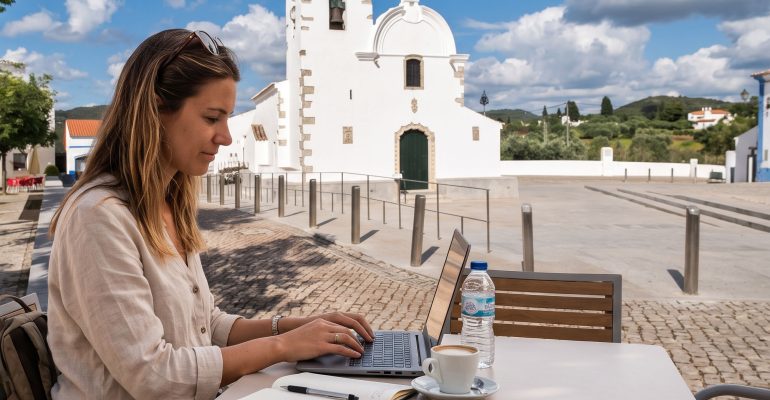
Portugal stands out once again as one of Europe’s most attractive destinations for remote workers, ranking third in the 2026 list of the best European countries for digital nomads. The ranking, compiled by LEI Register, analysed 40 European countries across 19 indicators, including cost of living, housing, internet speed, safety, healthcare, coworking spaces and visa access conditions.
The study puts Estonia in first place, followed by Iceland, with Portugal completing the podium. The result confirms the country’s prominent position in an increasingly competitive international market, where quality of life, digital infrastructure and the ease of working remotely play a decisive role.
Portugal’s main strengths include good internet speeds, a high level of English proficiency and the availability of specific digital nomad visas. The study also highlights the country’s ability to welcome international professionals who want to combine their work with quality of life.
Despite these advantages, the cost of housing remains one of the main challenges. According to the ranking data, the average monthly rent for a one-bedroom apartment in the centre of Portuguese cities is 919 euros. The one-year digital nomad visa has a stated cost of 80 euros.
Estonia leads and Montenegro stands out for long stays
Estonia takes first place, benefiting from a relatively affordable cost of living, good levels of safety and conditions that favour remote work. Iceland comes second, standing out above all for its internet speed, its coworking offer and its safety, despite high living costs.
After Portugal, Montenegro ranks fourth, thanks to lower housing costs and the possibility of obtaining a visa valid for up to 730 days. Croatia completes the top five, also benefiting from favourable conditions for extended stays.
The top 10 is completed by Slovenia, Czechia, Spain, Lithuania and Romania.
Portugal strengthens its international positioning
Portugal’s third-place finish is recognition of its ability to attract professionals who carry out their work from any location, without depending on a physical office.
Beyond the large urban centres, this phenomenon is also an opportunity for inland areas, which can benefit from the arrival of international workers, local economic dynamism and the demand for life experiences outside the big cities.
With good digital infrastructure, welcoming conditions and territorial diversity, Portugal has the characteristics to strengthen its role as a benchmark destination for digital nomads in Europe.